Knowledge Hub
Container Loading Guide
Maximize space, minimize cost. Best practices for loading tires into 20ft and 40ft shipping containers.
Maximize space, minimize cost. Best practices for loading tires into 20ft and 40ft shipping containers.
| Type | Internal Length | Internal Width | Internal Height | Max Payload |
|---|---|---|---|---|
| 20ft Standard | 5.9 m | 2.35 m | 2.39 m | 28,000 kg |
| 40ft Standard | 12.03 m | 2.35 m | 2.39 m | 26,000 kg |
| 40ft High Cube | 12.03 m | 2.35 m | 2.69 m | 26,000 kg |
For tire shipments, the 40ft High Cube is often the best value because the extra 30 cm of height allows for additional vertical stacking of PCR tires. However, weight limits must always be respected.
| Tire Type | Size Example | 20ft Qty | 40ft HC Qty | Avg Weight |
|---|---|---|---|---|
| PCR | 195/65R15 | ~1,200 | ~2,600 | 9 kg each |
| PCR | 205/55R16 | ~1,000 | ~2,200 | 10 kg each |
| TBR | 315/80R22.5 | ~160 | ~340 | 65 kg each |
| TBR | 12R22.5 | ~180 | ~380 | 58 kg each |
| OTR | 17.5R25 | ~20 | ~44 | 280 kg each |
| OTR | 23.5R25 | ~12 | ~26 | 450 kg each |
Note: Quantities are approximate and depend on exact tire dimensions, stacking pattern, and whether tires are wrapped or unwrapped. Always confirm final loading plans with your freight forwarder.
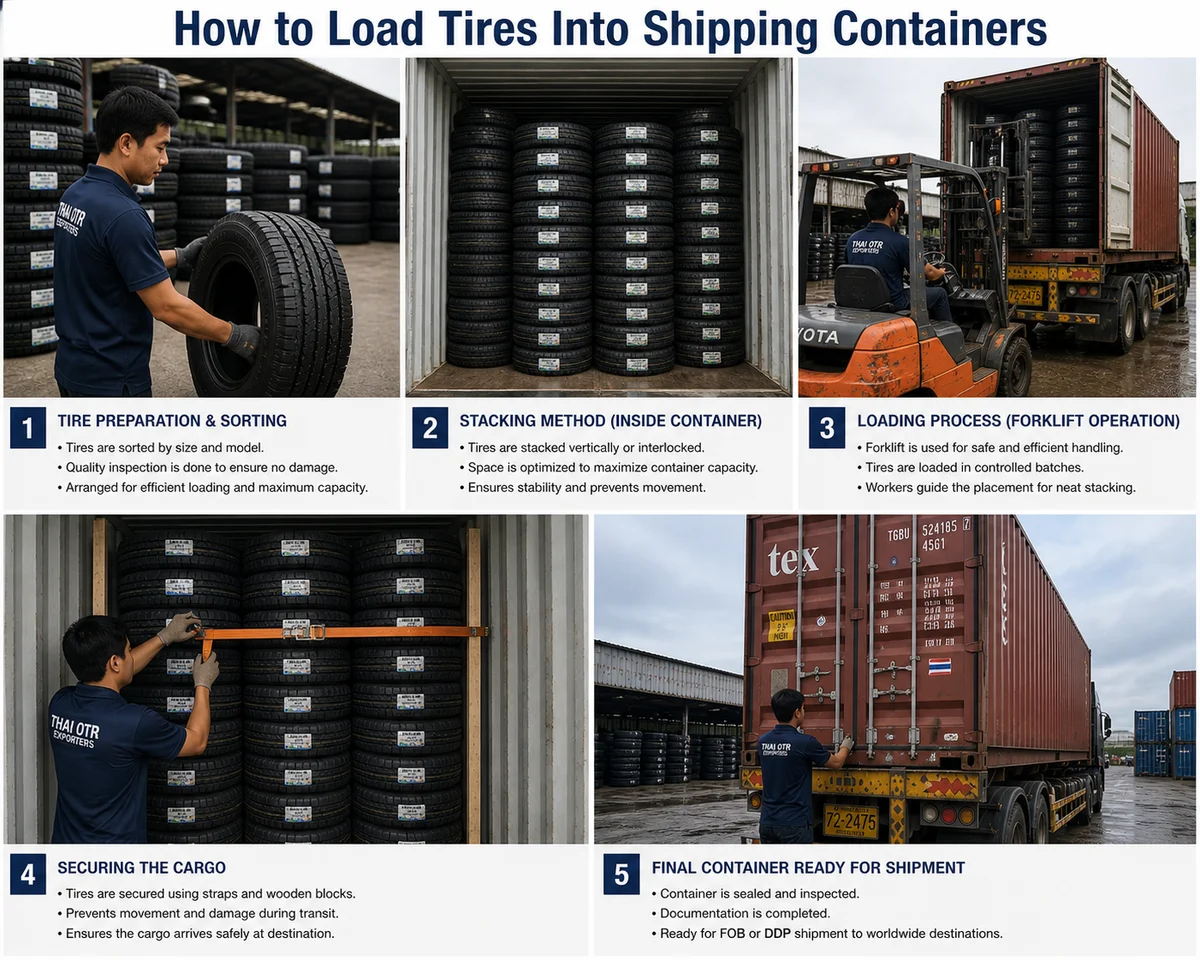
PCR tires are typically stacked vertically (standing on their tread face) in rows. This prevents deformation and allows maximum density. Rows are usually 4–5 tires wide across the container.
TBR tires can be stacked horizontally in nested pairs (one tire inverted into another) to reduce space. This "nest stacking" can increase capacity by 15–20% compared to single stacking.
Large OTR tires often cannot be stacked more than 2–3 high due to weight. They may be loaded on their sides with protective dunnage between them to prevent damage during transit.
A 40ft container can hold approximately 2,200–2,800 PCR tires, 280–320 TBR tires, or 40–60 OTR tires depending on size and stacking method. Mixed loads optimize space by combining smaller PCR tires with larger OTR tires in the upper tiers.
Tires should be stacked vertically (standing on their treads) to prevent bead deformation. Place heaviest tires at the bottom, secure with lashing straps, and use dunnage to prevent shifting during transit. Never exceed container weight limits.
A full 40ft container of PCR tires weighs approximately 18–22 metric tons. TBR containers range 22–26 tons. OTR containers vary widely from 15–25 tons depending on tire sizes. Always stay below the 28-ton gross weight limit for standard containers.
Yes. THAI OTR SUPPLIERS provides professional loading supervision at our Bangkok warehouse. We document every layer with photos, verify counts, and ensure proper weight distribution before sealing the container for export.
We handle professional loading, documentation, and port delivery for every order.
Get a Shipping Quote