Knowledge Hub
OTR Tire Guide
Everything you need to know about Off-The-Road tires for construction, mining, and quarry operations.
Everything you need to know about Off-The-Road tires for construction, mining, and quarry operations.
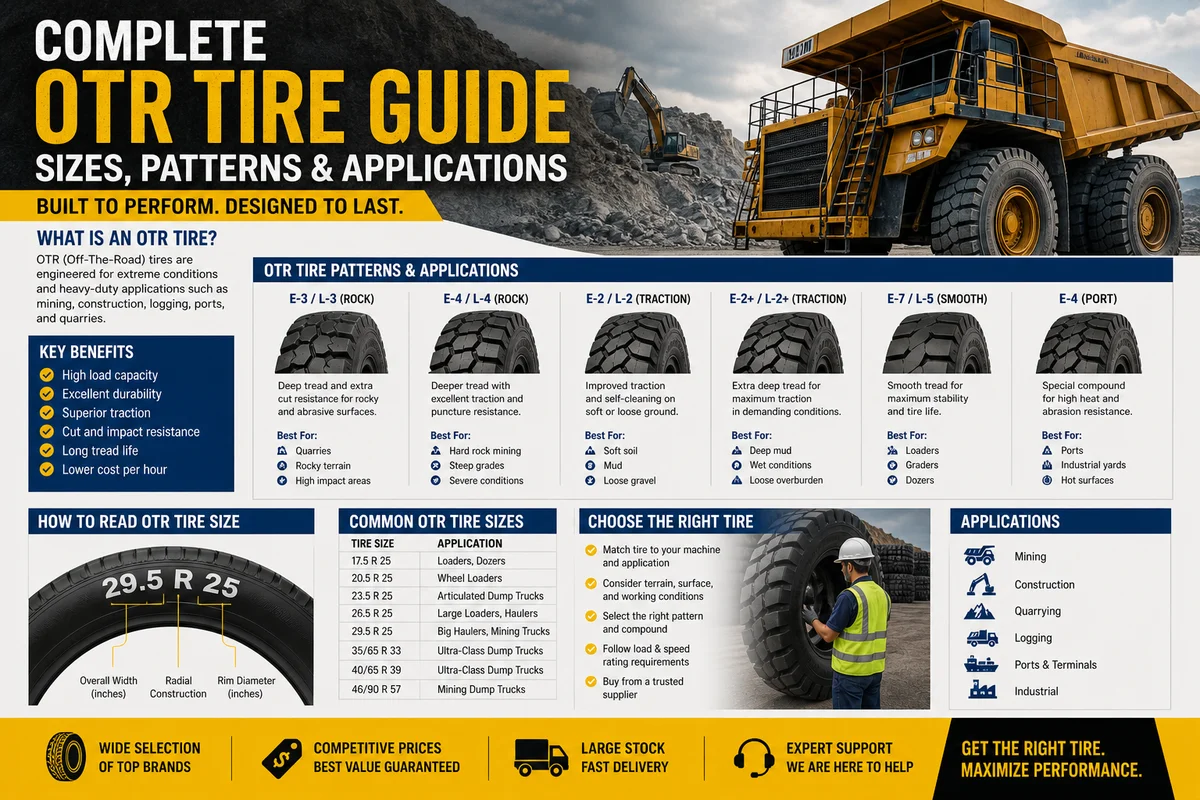
Off-The-Road (OTR) tires are heavy-duty tires designed for vehicles that operate on unpaved surfaces such as dirt, gravel, mud, and rock. Unlike standard truck or car tires, OTR tires are built to withstand extreme loads, harsh terrain, and abrasive conditions found in mining, construction, quarrying, and port operations.
OTR tires are categorized by their tread depth, ply rating, and construction type (radial vs. bias). Radial OTR tires are increasingly preferred for their longer wear life, better heat dissipation, and fuel efficiency, while bias OTR tires remain popular for certain applications due to their rugged sidewalls and lower cost.
| Size | Equipment Type | Common PR | Application |
|---|---|---|---|
| 17.5R25 | Wheel Loaders, Graders | 16-20 PR | Construction, Quarry |
| 20.5R25 | Medium Loaders | 16-20 PR | General Earthmoving |
| 23.5R25 | Large Wheel Loaders | 20 PR | Heavy Construction, Mining |
| 26.5R25 | Articulated Dump Trucks | 20-28 PR | Mining, Quarry |
| 29.5R25 | Large Articulated Haulers | 28 PR | Surface Mining |
Balanced tread design for loaders and graders operating on mixed surfaces. Good traction and even wear for general construction work.
Deeper tread blocks with reinforced shoulders for extreme cut and chip resistance in quarries and mining applications.
Maximum tread depth for the harshest conditions. Used in severe mining and demolition where tire damage is highest.
Radial OTR tires have steel belts running at 90 degrees to the tread centerline, providing better heat dissipation, longer wear, and fuel efficiency. Bias OTR tires have nylon plies running at alternating angles, offering stronger sidewalls and lower cost but shorter tread life.
OTR tire life varies significantly based on application. Construction loaders may see 2,000–4,000 hours, while mining haulers can achieve 6,000+ hours with proper maintenance and matched tread patterns.
Ply rating indicates load capacity. For small loaders (17.5R25), 16–20 PR is typical. For large mining trucks (26.5R25+), 28 PR or higher is required. Always check your equipment manufacturer's specification.
We supply 17.5R25, 23.5R25, 26.5R25 and more — direct from Thailand at competitive FOB prices.
Request OTR Quote