Knowledge Hub
PCR Tire Guide
Passenger car and SUV tire sizes, speed ratings, load indexes, and performance characteristics explained.
Passenger car and SUV tire sizes, speed ratings, load indexes, and performance characteristics explained.
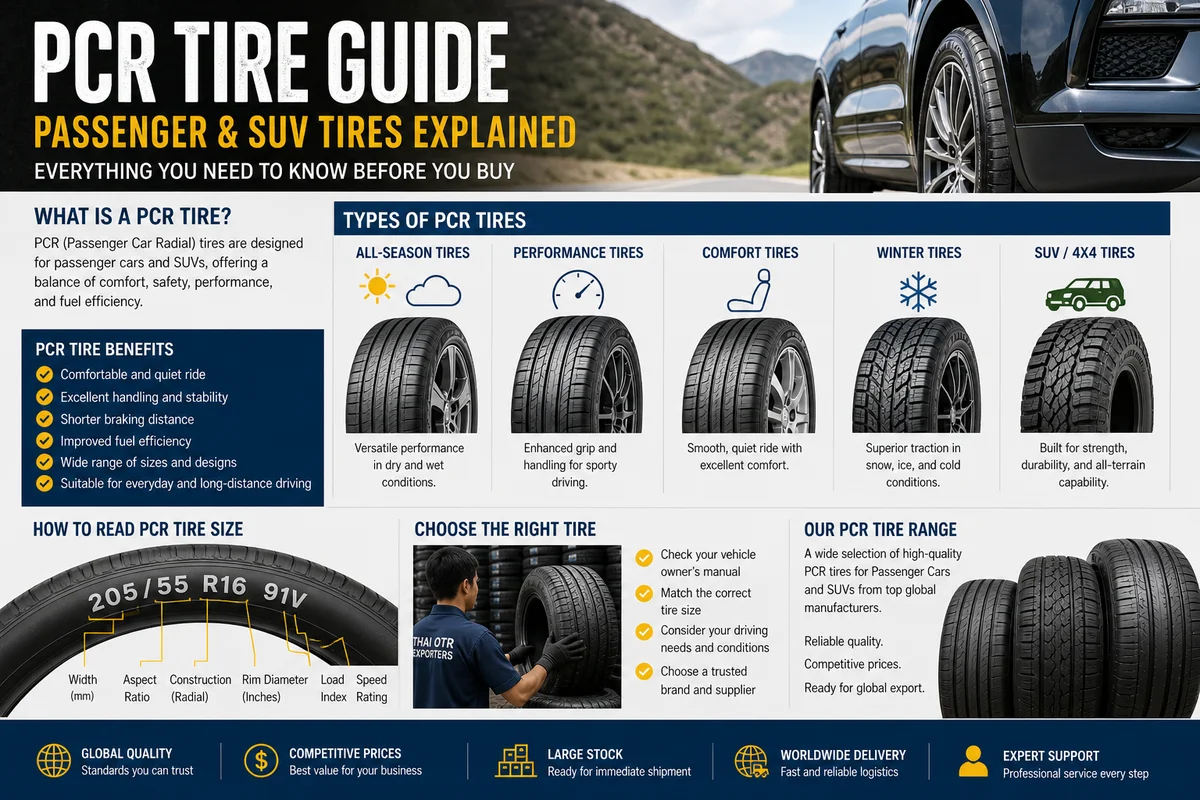
Passenger Car Radial (PCR) tires are designed for cars, SUVs, crossovers, and light-duty vehicles. They account for the largest segment of the global tire market and are characterized by their emphasis on comfort, fuel efficiency, wet grip, and low noise levels.
PCR tires use radial construction with polyester or nylon body plies and steel belts under the tread. The tread compound and pattern design vary significantly based on the intended use — from high-mileage touring tires to high-performance summer tires and all-weather options.
| Size | Vehicle Type | Load/Speed | Common Fitment |
|---|---|---|---|
| 195/65R15 | Compact Sedan | 91H | Toyota Vios, Honda City |
| 205/55R16 | Mid-Size Sedan | 91V | Honda Civic, Mazda 3 |
| 215/60R16 | Compact SUV | 95H | Honda HR-V, Toyota Corolla Cross |
| 225/45R17 | Sport Compact | 91W | BMW 3-Series, Mercedes C-Class |
| 235/65R17 | Mid-Size SUV | 104H | Toyota Fortuner, Ford Everest |
A numerical code indicating the maximum weight each tire can support. For example, 91 = 615 kg per tire. For a typical car with four tires, that is 2,460 kg total capacity.
A letter indicating the maximum speed the tire is certified for. H = 210 km/h, V = 240 km/h, W = 270 km/h. Always match or exceed your vehicle's top speed capability.
A comparative rating based on test tire wear. A grade of 300 means the tire should last 3x as long as the test standard. Higher numbers = longer tread life.
It is possible within limits, but we recommend staying within 3% of the original overall diameter to avoid speedometer errors, ABS issues, and clearance problems. Always consult a tire professional before deviating from OE specifications.
Most PCR tires should be replaced when tread depth reaches 2/32 inch (1.6 mm), or after 5–6 years regardless of tread depth due to rubber aging. In hot tropical climates, 4–5 years is a safer replacement interval.
Summer tires use a harder compound optimized for warm temperatures, offering superior dry and wet grip. All-season tires use a compromise compound that remains flexible in cooler temperatures but sacrifices some peak performance. In tropical climates, summer tires are generally the better choice.
We supply 195/65R15, 205/55R16 and more — direct from Thailand at competitive FOB prices.
Request PCR Quote