Understanding Container Sizes for Tire Shipping
When importing truck tires from Thailand, understanding container dimensions is crucial for calculating shipping costs and planning your orders. The two most common container sizes used for tire export are the 20-foot and 40-foot shipping containers.
A 20ft container has internal dimensions of approximately 5.9m (19.5ft) in length, 2.35m (7.7ft) in width, and 2.39m (7.8ft) in height. This gives you roughly 33 cubic meters of usable space. A 40ft container doubles the length to 12.03m (39.5ft) while maintaining the same width and height, providing approximately 67 cubic meters of space.
Truck Tire Capacity by Size
The number of tires that fit in a container depends on the tire size, loading method, and weight restrictions. Below is a comprehensive breakdown for the most popular truck tire sizes exported from Thailand.
| Tire Size | 20ft Container | 40ft Container | Average Weight |
|---|---|---|---|
| 11R22.5 | 140-150 units | 280-300 units | 48-52 kg |
| 295/75R22.5 | 135-145 units | 270-290 units | 50-54 kg |
| 315/80R22.5 | 120-130 units | 240-260 units | 58-62 kg |
| 12R22.5 | 130-140 units | 260-280 units | 52-56 kg |
| 285/75R24.5 | 125-135 units | 250-270 units | 54-58 kg |
Table: Estimated truck tire capacity by size for standard shipping containers
These estimates assume professional loading techniques using the interlocking stack pattern. Actual capacity may vary slightly based on specific tire brand, tread pattern, and exact dimensions.
Professional Loading Strategies
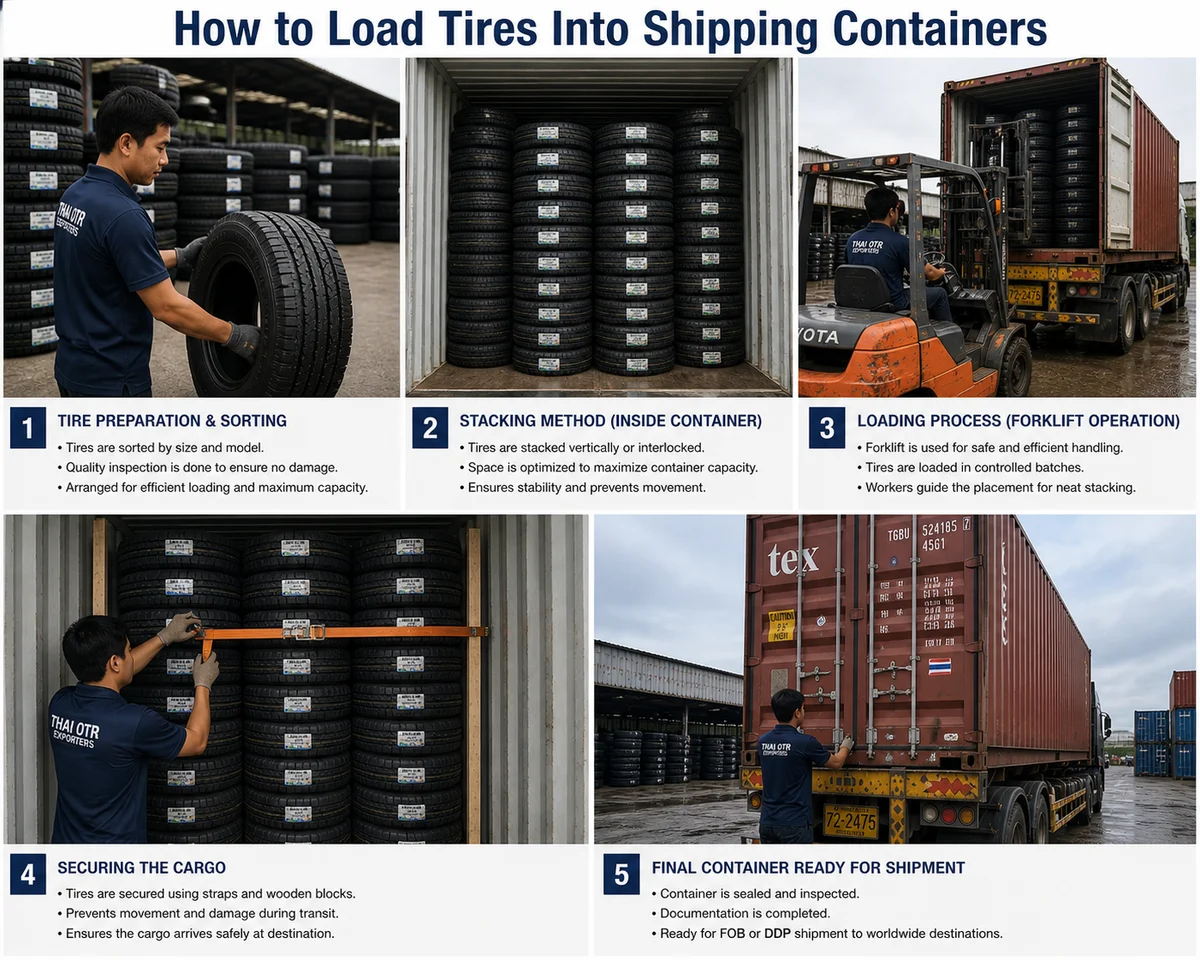
Maximizing container space requires professional loading techniques. Thai tire exporters use several proven methods to optimize tire placement and ensure safe transit.
Interlocking Stack Pattern
The interlocking method alternates tire orientation every 2-3 rows, creating a stable stack that maximizes space while preventing movement during ocean transit. This is the most common loading technique for TBR (Truck and Bus Radial) tires.
Tires are loaded standing upright on their tread, with each row slightly offset from the row below. This creates a honeycomb-like structure that uses space efficiently and distributes weight evenly across the container floor.
Alternating Orientation Method
For mixed-size containers, the alternating orientation method allows you to combine different tire sizes while maintaining stability. Larger tires form the base layers, with smaller tires stacked on top.
Weight Distribution
Proper weight distribution is critical. Heavier tires should be placed on the bottom and toward the center of the container. This prevents shifting during transit and ensures the container remains balanced on the vessel.
Weight Limits & Regulations
Understanding weight restrictions is essential for planning your tire imports. Both container payload limits and destination country regulations affect how many tires you can legally ship.
| Container Type | Max Payload | Typical Tire Weight | Weight-Limited Capacity |
|---|---|---|---|
| 20ft | 21,770 kg (48,000 lbs) | 50 kg average | ~435 tires |
| 40ft | 26,680 kg (58,800 lbs) | 50 kg average | ~533 tires |
Table: Maximum weight limits for container shipments
However, road weight restrictions in destination countries often limit practical capacity. In the USA, for example, maximum truck weights on highways typically limit 20ft container loads to 18-20 tons to comply with state regulations.
Cost Optimization Tips
Maximizing container efficiency directly reduces your per-tire shipping cost. Here are proven strategies to optimize your tire imports from Thailand:
1. Order Full Container Loads (FCL)
Full container loads are significantly cheaper per unit than Less-than-Container-Load (LCL) shipments. Always try to order quantities that fill complete containers.
2. Mix Sizes Strategically
If you need multiple tire sizes, work with your supplier to create a mixed container that maximizes space. Smaller tires can fill gaps between larger tires, increasing total capacity.
3. Consider 40ft Over 20ft
While 40ft containers cost more, they typically offer better per-tire shipping costs because you can fit more than double the tires in a single container.
4. Plan for Weight Restrictions
Research road weight limits in your destination country. Planning around these limits upfront prevents costly fines and delays at ports.
5. Use FOB Bangkok Pricing
FOB (Free On Board) pricing gives you control over freight costs. You can choose your own freight forwarder and negotiate competitive ocean freight rates.
Need Help Planning Your Tire Shipment?
Our export team can help you calculate optimal container loads and arrange FOB Bangkok shipping for your truck tire order.
Frequently Asked Questions
How many 11R22.5 tires fit in a 40ft container?
A 40ft container can hold approximately 280-300 tires in size 11R22.5 when stacked using professional interlocking patterns. The exact number depends on the specific tire brand and loading technique used.
What is the maximum weight for a 20ft container?
The maximum payload for a 20ft container is approximately 21,770 kg (48,000 lbs). However, road weight restrictions in destination countries may limit this to 18-20 tons for safety compliance and legal transport.
Can I mix different tire sizes in one container?
Yes, mixed container loading is possible and often recommended for distributors. We can help you optimize the load combination based on your market demand and weight limits. Typically, you can mix 2-3 different sizes in one container.
How long does shipping from Thailand take?
Transit times vary by destination: USA West Coast (18-22 days), USA East Coast (28-35 days), Canada West Coast (20-25 days), Canada East Coast (35-42 days). These times are from port of departure to port of arrival.
What documents are needed for tire import?
Standard import documents include: Commercial Invoice, Packing List, Bill of Lading, Certificate of Origin, and any required certifications (DOT for USA, ECE for Europe). We provide all necessary export documentation.